
How AI Agents Can Automate Business Operations in 2026
Explain AI agents in simple language; examples for sales follow-ups, customer support, reporting, HR, and internal workflows; where human approval is still necessary.
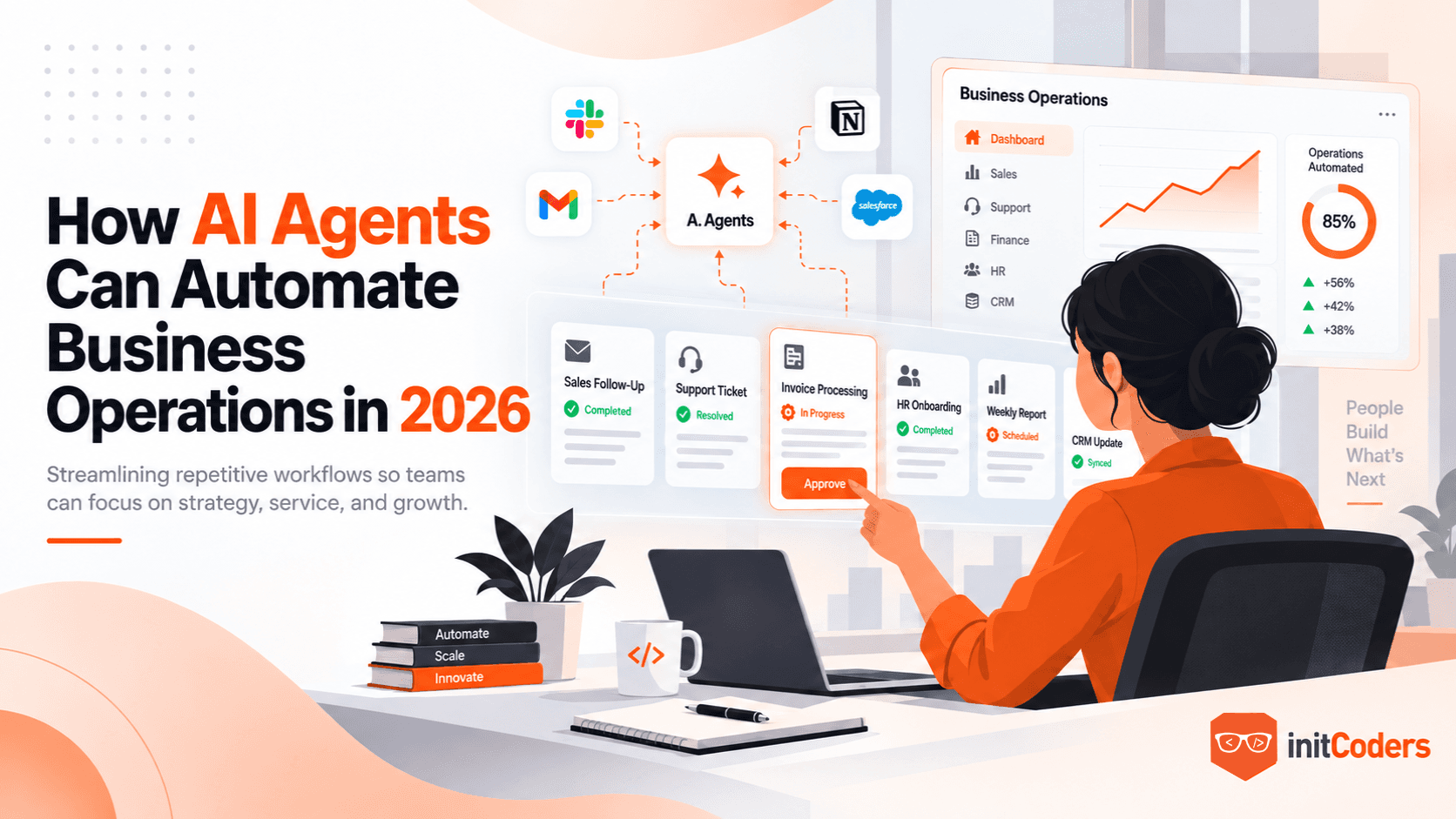
Most teams still treat AI like a smarter search box. You type. It talks. You copy the answer into the next tool.
That was 2024. In 2026, the useful question is different: which pieces of work can an agent actually finish, and which ones still need a person to say yes.
McKinsey’s late-2025 survey found 88% of organizations using AI in at least one business function, 62% experimenting with AI agents, and 23% scaling an agentic AI system somewhere in the enterprise. McKinsey, The State of AI in 2025. Gartner expects 40% of enterprise applications to include task-specific AI agents by the end of 2026. Gartner, 40% of Enterprise Apps Will Feature Task-Specific AI Agents by 2026. KPMG’s global AI study also finds that trust remains a critical challenge, with 46% of people globally willing to trust AI systems. KPMG, Trust, Attitudes and Use of Artificial Intelligence: A Global Study 2025. That is not fear. That is people putting agents on real work and discovering what “real” means.
This piece is the plain-language version. What an agent is. Where it already earns its keep in sales, support, reporting, HR, and the boring internal stuff. And the line We will not cross: the model does not get to decide whether something needed approval.
An AI Agent, Without The Jargon
A chatbot answers a question.
An agent is given a job. It looks at the situation, pulls the right context, chooses the next step, uses a tool, checks the result, and keeps going until the job is done or it has to stop.
Think of a new hire in their second week. You would not ask them to “be the company.” You would say: check yesterday’s inbound leads, skip anyone who already booked a call, draft a follow-up in our tone, and put the draft in front of me before it goes out.
That is an agent. Not magic. A loop.
- See the trigger. A form fill. A ticket. 4 p.m. every Friday.
- Ground itself in your material. Policy, product docs, CRM notes, last week’s numbers. Not a guess from the open internet.
- Decide the next step inside rules you wrote.
- Act through tools. Search a knowledge base. Write a CRM field. Draft an email. Open a ticket. Hand the conversation to a person.
- Stop when the next action cannot be undone, costs money, or leaves the building.
If it cannot search your own documents, cannot take an action, and cannot hand off when it is lost, it is still a chatbot. Chatbots are fine. They are not operations.
The mistake We keep seeing is skipping the middle. Teams want the action without the grounding. Then the agent writes a confident email that contradicts the pricing page, or “closes” a ticket it did not actually resolve. Ground first. Then tools. Then autonomy, slowly.
Sales Follow-Ups: The Grind, Not The Close
Sales is where agents look impressive in a demo and quietly useful in production.
A good sales agent does the work reps hate and customers notice when it is late:
- Qualify the inbound against a rubric you already use. Budget, timeline, fit. Not “this person seems excited.”
- Draft the first follow-up from the form answers, the last call notes, and the page they were on.
- Nudge the deal that went quiet on day five, not day twenty-seven.
- Update the CRM so the next human does not start from a blank screen.
- Prep a one-page brief before the meeting: company, last objection, open quote.
OpenAI’s own sales team has talked about this shape: pull call notes and account research, qualify, draft the follow-up into the rep’s inbox. OpenAI, The State of Enterprise AI. Salesforce’s sales research makes the same broader case for agents supporting sellers while people retain the customer relationship. Salesforce, 91% of Indian Sales Professionals Say AI Agents Are Mission-Critical to Business Success.
What We would not let it do on day one: send the email. Quote a custom price. Promise a discount. Move a stage to “closed won.”
The follow-up is the job. The send is the approval. Those are not the same button.
A practical pattern that holds up: the agent can log the lead, score it, and write the draft in under a minute. A human spends thirty seconds on tone and whether this person should even get an email today. You did not remove the person. You removed the twenty minutes of tab-switching that used to happen first.
If a lead asks for something the knowledge base does not cover, the agent should not invent a package. It should capture the request and hand it to a human. Fake confidence in sales is expensive. It shows up as refunds and angry calls, not as a bad chatbot screenshot.
Customer Support: Answer What You Know, Escalate What You Don’t
Support is the clearest agent job in 2026 because the work is already a loop: question, lookup, action, confirm.
A support agent that is actually useful:
- Answers from your help center, policies, and past tickets, every time, not only on the first message.
- Handles small actions: reset a password flow, look up an order, share the right article, file the bug.
- Collects the missing details before a human ever sees the thread.
- Hands off when the customer is angry, the policy is ambiguous, or the next step is a refund, a legal threat, or “can you just make an exception.”
The failure mode is familiar. The agent sounds warm. It is also wrong. It quotes a policy from 2023. It apologizes and offers 20% off because that pattern showed up in training data.
Two rules We treat as non-negotiable:
Do Not Skip Retrieval For “Quick Replies.” The easy questions are exactly where a stale answer spreads. If the docs changed this morning, the agent should see that this morning.
When The Agent Is Out Of Its Depth, It Hands Off. It does not perform confidence. A conversation that needs a person should become a person, with the transcript attached, not a new “please hold” dead end.
Write actions in support are where you put the gate: refunds, account deletion, changing an email on file, anything that moves money or identity. Looking up an order status can run. Issuing the refund should pause.
The human in 2026 support is not reading every “how do We reset our password.” They are handling exceptions, unhappy customers, and the 4% of cases where the policy and the person disagree. That is the job support always was. Agents just stop drowning it.
Reporting: The Friday Tax
Every company We have been around has a Friday tax. Someone pulls numbers from three tools, pastes them into a deck, writes a paragraph that sounds like a person, and sends it at 6:12pm.
A reporting agent is allowed to be boring:
- Pull the same metrics, the same way, every week.
- Flag what moved more than the threshold you set.
- Draft the narrative in the voice your leadership already uses.
- Drop the draft where humans already look. Slack. Email. A shared doc.
This is one of the cleanest agent workloads because the action is mostly assemble and draft. The blast radius is small until someone forwards the wrong chart to a customer or a board.
So the approval here is not “did the SQL run.” It is “is this the story we want to tell.” Numbers can be right and still be the wrong framing. A dip in signups might be a tracking bug. An agent will narrate it as a demand problem unless a human who lives in the business says otherwise.
Let the agent own the pull and the first draft. Let a human own the sentence that starts with “we should.”
Also: log what it pulled. If leadership asks “where did this 14% come from,” you need a trail, not a shrug.
HR: High Volume, High Blast Radius
HR is where people get excited about agents and then remember that HR is people.
Good HR agent work in 2026 looks like:
- Answering “how many leave days do I have” and “what is the WFH policy in Bangalore” from the actual handbook.
- Guiding onboarding: equipment checklist, first-week docs, who to meet.
- Screening inbound applications against a written rubric, then ranking, not rejecting in the dark.
- Drafting the offer letter from a template after a human picked the candidate and the band.
- Routing payroll exceptions and expense questions to the right queue with the right fields filled.
Workday-class systems are already pushing this: agents that sit on people and finance data, follow existing permissions, and run the repetitive casework. Workday, Agent System of Record.
What still needs a human, every time:
- Hiring yes or no.
- Compensation exceptions.
- Performance ratings, promotions, PIPs.
- Anything that sounds like “we’re letting you go.”
- Medical, legal, or harassment reports. The agent can route. It does not counsel.
An HR agent that answers policy questions and pre-fills forms is a gift. An HR agent that “decides” someone’s career is a lawsuit with extra steps.
The other trap: employees will trust a fluent answer more than a PDF. If the handbook is messy, the agent will be fluently messy. Clean the source of truth first. Then put the agent in front of it. We have watched teams do this backwards and then blame the model.
Internal Workflows: The Copy-Paste That Runs The Company
This is the unsexy pile, and it is where agents pay rent.
Invoice arrived → extract fields → match PO → park it for approval if it is over the limit.
New customer signed → create the workspace → send the welcome sequence → ping success if onboarding stalls.
IT ticket → check the runbook → reset the thing that is always the thing → escalate if it is not.
A teammate asks in Slack → agent answers from internal docs, with a link, and files a ticket only when the docs have no answer.
These workflows used to be Zapier with a lot of “if this, then that.” Agents help when the input is messy. Emails that are not in the template. Tickets written by tired humans. A PDF that is almost an invoice.
Still: messy input does not mean unsupervised output. Read-only lookups and drafts can run. Creating records in the system of record, sending mail outside the company, changing permissions, deleting anything — those wait.
A pattern We like because it is honest: the agent prepares, the system enforces, the human confirms. If you put the approval inside the prompt (“please ask a human if this seems sensitive”), a clever model will talk itself out of asking. The gate has to live in the workflow. The model should not be able to skip it.
That is also why “just give it access to everything” is a bad 2026 idea. Give it the tools for this job. If it needs to send, make send a tool that requires a click. If it needs to pay, make pay a tool with a money ceiling. Permissions are the product.
Where A Human Still Has To Say Yes
We group this as a consequence test, not a vibe test.
Put a person in the loop when the next action is irreversible, expensive, regulated, or high blast radius. If two of those are true, it is not a debate.
| Let The Agent Run | Pause For A Person |
|---|---|
| Search docs, CRM, tickets | Send an email, Slack, or public post |
| Draft follow-ups, reports, replies | Promise pricing, SLAs, or legal language |
| Score a lead, rank a resume, route a ticket | Hire, fire, promote, discipline |
| Fill the weekly metrics draft | Forward the report outside the team |
| Look up an order or leave balance | Refund, pay, or move money above a small cap |
| Collect missing fields | Delete data, change permissions, ship to production |
| Hand off when unsure | “I’ll handle it” when the customer is furious |
A few specifics that keep coming up:
Anything That Leaves The Building. Customer email, public reply, vendor message. Draft freely. Send with a person in the loop, or at least a delay window you can kill.
Money. Small, reversible, policy-bound refunds can be a later privilege after you have logs. Wires, payroll, large credits: hard gate. No agent should charge a card because it felt sure.
Identity And Access. Resetting a password through a known flow is support. Granting admin, opening a production firewall, or changing who owns a record is not.
People Decisions. HR and legal are not “sensitive prompts.” They are human jobs with an agent as a clerk.
Commitments. “We can do that by Thursday” is a contract with extra charm. If it is not in the knowledge base as a standard promise, it waits.
Two more things the research keeps proving, and that match how this work actually feels:
First, do not review everything. If the queue is 200 “approve” clicks an hour, people rubber-stamp. Auto-run the high-confidence, low-blast work. Send humans the uncertain tail and the high-consequence actions. KPMG’s jump in required validation is this instinct becoming policy.
Second, oversight has to be real. The EU AI Act’s Article 14 requires appropriate human oversight for high-risk systems, including measures that enable people to understand limitations, monitor operation, intervene, or stop the system when appropriate. European Commission, AI Act. Clicking approve because the box is green is not oversight. Show the reviewer what the agent used, what it is unsure about, and what happens if they say yes.
Gartner predicts that by 2027, 40% of enterprises will demote or decommission autonomous AI agents because of governance failures. Gartner, 40% of Enterprises Will Demote or Decommission Autonomous AI Agents Due to Governance Failures. The teams that keep theirs are not the ones who said “fully autonomous.” They picked one high-volume workflow, grounded it in their own data, put gates on send/pay/delete, and measured hours returned, not demo wow.
How To Start In 2026 Without Boiling The Company
Pick one job that is frequent, written down, and annoying. Lead follow-up. L1 support. The Friday report. Leave-policy questions.
Write the definition of done in one paragraph. If you cannot, the agent cannot either.
Give it the source of truth before you give it tools. Docs, CRM fields, the runbook. If retrieval is optional, answers will drift.
Give it a short tool list. Search. Draft. Log. Escalate. Not “the whole SaaS stack.”
Put the approval outside the model. Sending, paying, deleting, promising, hiring.
Watch it for a few weeks like a new hire. Read the misses. Tighten the docs. Then widen the leash on the tasks that were clean.
You will not automate the business. You will take the copy-paste out of the business so people can do the parts that still need judgment, timing, and the willingness to be wrong in public.
That is the 2026 version of this. Agents that finish the next step. Humans who still own the step that cannot be undone.