AI-Ready Websites: How to Optimize Your Business for ChatGPT and AI Search
We asked ChatGPT to recommend a development agency in our own city and did not show up. Here is what changed once we rebuilt our site to be quotable, not just rankable.
AI-Ready Websites: How to Optimize Your Business for ChatGPT and AI Search
A few months back we asked ChatGPT the question a prospect might ask: "Which development companies should I consider for a custom web application?" It named three companies. We were not one of them.
Our search rankings were fine. Our site speed was fine. But a whole channel of buyers — the ones who now describe their problem to a chatbot instead of typing keywords into Google — never saw us, and there was no dashboard telling us we had been left out.
That gap is what people now call GEO (Generative Engine Optimization) or AEO (Answer Engine Optimization) — two names for the same shift. You will see people argue about which term wins. Skip that argument. What matters is the mechanic underneath: you used to optimize to be listed, and now you also optimize to be quoted, because a model writes one paragraph and names two or three sources, and there is no page two.
Here is what we changed on our own site once we noticed the gap, and what we now build into every client site by default.
Four steps stand between your page and the answer
Whether it is ChatGPT with browsing, Perplexity, or a Google AI Overview, the pipeline is roughly the same: the question gets split into narrower searches, a handful of pages get fetched, relevant chunks get pulled out of the HTML, and one answer gets written with a couple of citations.
Every one of those is a filter. A slow page, content that only appears after the JavaScript runs, a good point buried in paragraph nine — each one quietly drops you out before the citation gets picked. So the real goal is simple to state, even if it takes real work to hit: make the useful part of your page easy to fetch, easy to find, and easy to lift.
If it is not in the HTML, it does not exist
This is the check we run first on any site, ours included, and it still catches the most sites.
Open your most important page and view the actual page source — not the DevTools inspector, which shows the DOM after scripts have run. Search for your key sentence. If it is not there, nothing else in this post will help, because a client-rendered page that paints after hydration is often invisible to model crawlers even when Google copes with it fine.
Server rendering or static generation is the fix, and it is a big part of why we build on Next.js by default — the content exists in the response, not in a render queue.
Write the way you'd want to be quoted
Models lift spans of text, not whole pages, so the structure of a paragraph decides whether a clean span exists at all.
Put the answer in the first two or three sentences of a section, then explain it — the classic essay habit of building up to a conclusion works against you here, because the conclusion is exactly what gets cut off. Beyond that, a few habits pay for themselves: headings phrased the way a person actually asks ("How much does a custom CRM cost in India?" beats "Pricing"), paragraphs short enough to stand alone, tables for comparisons and lists for sequences, and real numbers over vague claims — "shipped in six weeks on Next.js 16" is quotable, "rapid delivery" is not.
FAQs are underrated because they match the shape of the job
A well-written FAQ block is already a question paired with an answer, which is exactly the unit a model is trying to build. That is why it punches above its weight — but only when the questions are the ones your sales team actually gets, not keyword filler pulled from a tool.
Fifty honest words answering "do you work with clients outside India?" earns more citations than another long thought-leadership piece. Keep each answer complete on its own, mark it up with FAQPage schema, and put a block on every service page — not just one buried /faq route.
Schema removes doubt, it does not replace substance
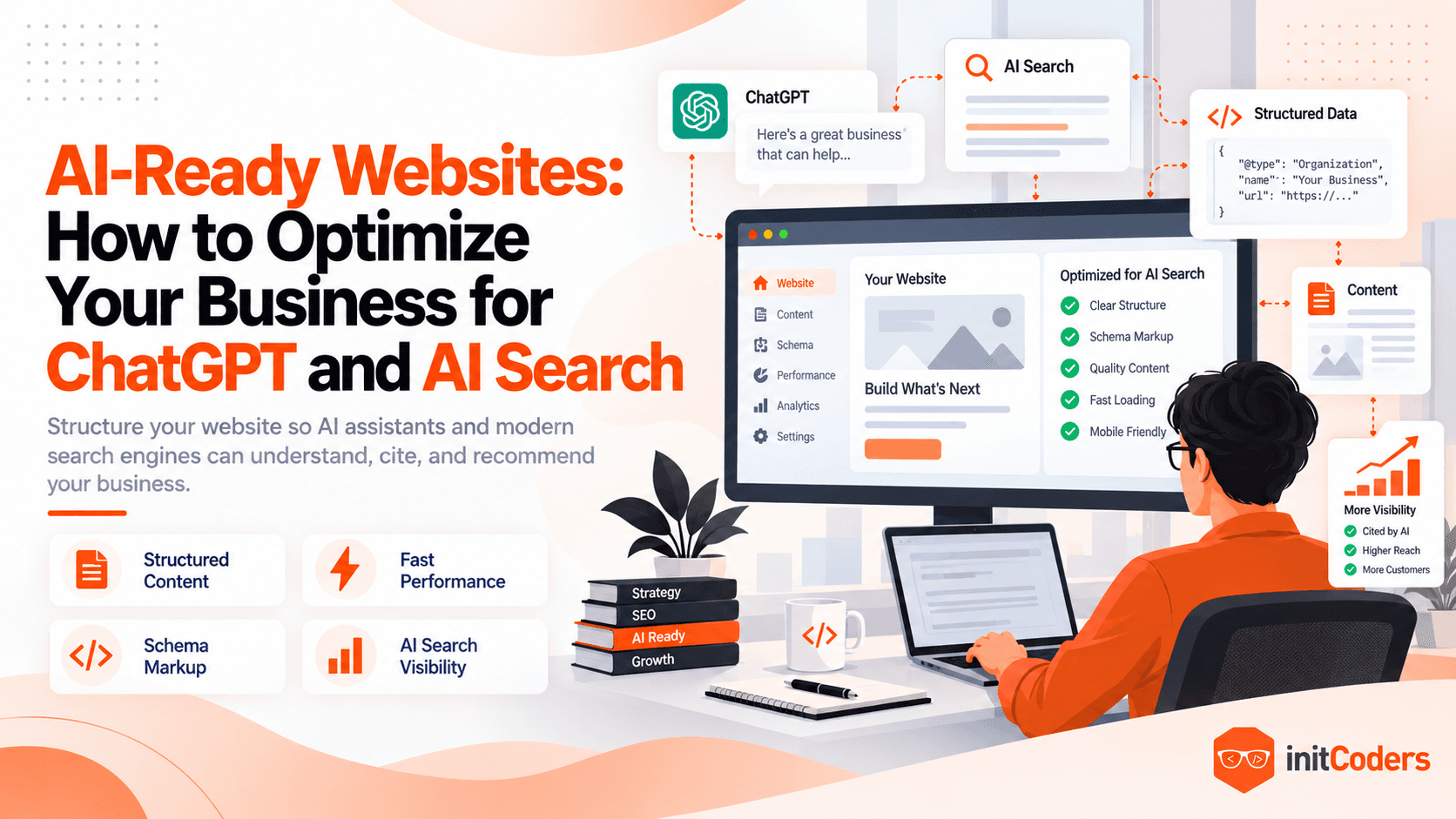
Structured data will not rank a thin page. What it does is tell a machine, without ambiguity, which company, which service, which page. The set worth having on a business site: Organization, WebSite, Service on each offering page, FAQPage wherever the FAQs are real, Article with dateModified on posts, and LocalBusiness if geography matters to your buyers.
One thing we learned the hard way: keep the details identical everywhere. JSON-LD, footer, and your Google Business Profile all naming the company slightly differently reintroduces the exact ambiguity you were trying to remove.
Depth beats volume, every time
A model leans on sources that read as the canonical answer for a topic, and a blog with thirty unrelated posts does not read as canonical — a cluster does. One deep page on the thing you actually want to own, six to ten supporting posts on the sub-questions around it, and internal links tying them together, works better than the same word count spread across unrelated topics.
The off-site half matters too and gets skipped more often: consistent company details across LinkedIn and directory listings, case studies with real numbers, and a named author with an actual bio instead of "Admin." Independent sources agreeing with each other carries more weight than one site insisting on its own authority.
A few technical habits worth adopting
Semantic HTML — real headings, lists, and tables instead of nested divs — costs nothing and helps every crawler, human or otherwise. An llms.txt file at your root, a short index of your important pages with one-line descriptions, is a twenty-minute job with reasonable odds of being read; if you have documentation-style content worth ingesting in full, llms-full.txt does the same thing with the full page content in one file instead of a list of links.
robots.txt is worth a deliberate pass too. Google-Extended is the one people miss — it controls whether Google can use your content to improve Gemini and AI Overviews, separate from ordinary Googlebot indexing, so you can allow one and block the other. GPTBot, PerplexityBot, and ClaudeBot are the equivalents for OpenAI, Perplexity, and Anthropic. Blocking any of them is a legitimate call. Just make it on purpose.
The numbers you should watch will change
Here is the part most people don't expect: you can do everything above correctly and still watch organic clicks stay flat, because the user got their answer inside the chat and never clicked through. That is not the campaign failing — it just does not show up on a traffic graph the way a click does.
So watch different things. Run your best buyer questions through ChatGPT, Perplexity, and Gemini once a month and note who gets named — Gemini and Google's AI Overviews lean heavily on the same index and Search Console signals that already drive your normal rankings, so a page that ranks well there often gets picked up faster than it does in ChatGPT. Watch referral traffic from chatgpt.com and perplexity.ai in analytics, watch AI crawler activity in your server logs even when it produces no click, and watch branded search volume — a rise there with flat clicks usually means people heard your name in a chat and searched for it afterward. Once you're tracking more than a handful of queries by hand starts to hurt, tools like Profound, Otterly, or the AI-visibility features now built into Semrush and Ahrefs will do it on a schedule.
When we would not chase this
Not every business needs to obsess over this yet. If your buyers are entirely local and find you through referrals and Google Maps, the effort is better spent elsewhere. If you are pre-product and content is thin by necessity, a stronger page ten months from now beats ten weak pages today. And if a topic genuinely has no factual answer — pure opinion, pure taste — no amount of schema will make a model treat it as citable fact, nor should it.
What to do next
Three checks tell you where you actually stand:
- View source on your three most important pages — is the content there, or is it waiting on JavaScript?
- Ask your ten best buyer questions to ChatGPT and Perplexity, and write down who gets named instead of you.
- Pick one service page and rewrite it so the answer sits in the first two sentences of each section, with a real FAQ block underneath.
That second step is the one that usually creates the urgency. It did for us.